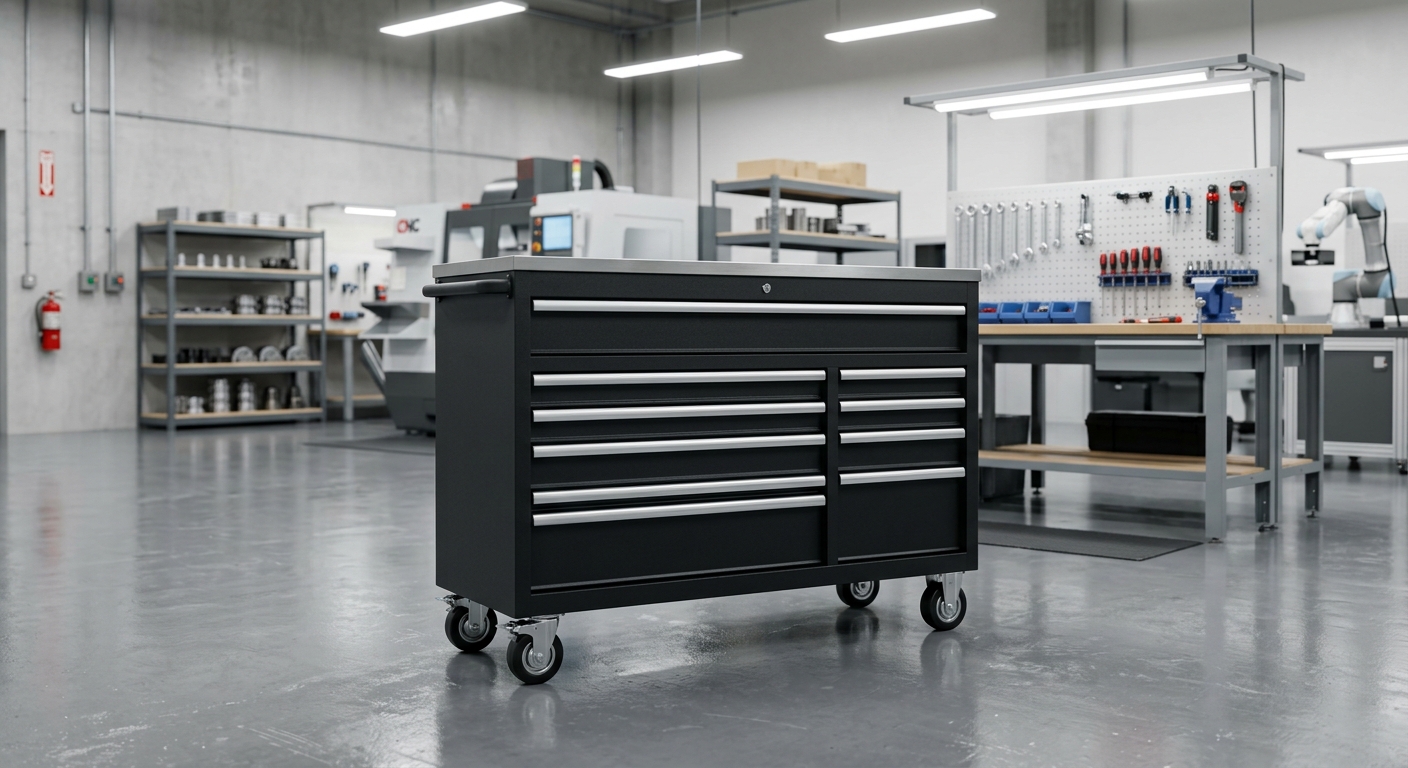
Sourcing heavy duty tool storage systems requires more than just checking dimensions on a spec sheet. For B2B importers, distributors, and procurement teams, the difference between a profitable product line and a margin-draining recall often comes down to steel gauge, drawer slide integrity, and export packaging. This guide breaks down how to evaluate industrial tool cabinet manufacturers, lock in specifications, and manage OEM/ODM production risks.
Key Takeaways
- Material Baseline: Prioritize 18-gauge to 21-gauge cold-rolled steel for structural integrity in industrial settings.
- Load Verification: Industrial-grade units must support 100-250 lbs per drawer to prevent structural failure under heavy tool loads.
- Commercial Risk Mitigation: Treat export packaging as a critical commercial risk; mandate corner protection and drop-testing to avoid margin-killing transit damage.
- Spec Control: Freeze all OEM/ODM specifications, including MOQ rules for mixed SKUs and exact coating codes, during the RFQ phase to protect lead times.
- Supplier Auditing: Evaluate factories based on automated manufacturing capabilities, raw material sourcing power, and in-house testing infrastructure.
Recurring Buyer Friction Patterns
When evaluating B2B wholesale tool storage solutions, procurement teams must look beyond the spec sheet and understand how end-users actually interact with the equipment. Public discussions among professionals highlight a strong shift in organization needs. For example, buyers frequently express frustration with standard molded cases, actively seeking rolling bins and deep drawers that accommodate bulky cordless power tools. Furthermore, while many setups cater heavily to automotive mechanics, there is a distinct, underserved demand for custom heavy duty tool chests for workshops in welding, aviation, and general manufacturing.
On the risk side, buyer feedback patterns frequently expose critical structural failures in consumer-grade units. End-users consistently label cheaper alternatives as "very flimsy" and "not very durable" when subjected to professional use. For industrial grade tool box suppliers, this validates the necessity of specifying thicker steel gauges and heavy-duty drawer slides. B2B buyers must prioritize these structural upgrades to prevent the functional failures seen in cheaper models and protect their brand reputation.
Core Specifications for Heavy Duty Tool Storage Systems
Material Specifications and Steel Gauge
The foundation of any reliable unit is cold-rolled steel (CRS). The standard for heavy-duty applications ranges from 18-gauge (thicker, used for frames and bases) to 21-gauge (used for drawers and side panels). Specifying powder coated steel tool storage is essential for corrosion resistance, requiring a thickness of 60-80 microns to withstand chemical spills, oils, and abrasions common in industrial environments.
Execution Note: When sourcing heavy duty steel tool cabinets bulk, procurement teams must verify that the heavy duty tool storage systems factory does not substitute thinner gauges during mass production to cut costs. Partnering with reputable industrial tool cabinet manufacturers ensures material consistency across batches.
Drawer Slides and Load Capacity
The longevity of workshop tool storage systems procurement hinges on drawer slide quality. Ball-bearing slides are mandatory, with heavy-duty models requiring double-slide configurations for deep or bottom drawers. Standard industrial load capacities start at 100 lbs (45 kg) per drawer, while premium heavy duty modular tool storage units can support up to 250 lbs (113 kg) per drawer.
Execution Note: Smooth operation under maximum load is a critical QC checkpoint. Require static load testing on fully extended drawer slides before approving the pre-production sample.
Casters and Mobility Features
To maximize rolling tool cabinet load capacity, casters must support the total dynamic weight of the fully loaded unit. Standard configurations include two rigid casters and two swivel casters equipped with toe brakes. Materials like Thermoplastic Rubber (TPR) or Polyurethane (PU) are preferred for their oil resistance, shock absorption, and non-marking properties on concrete factory floors.
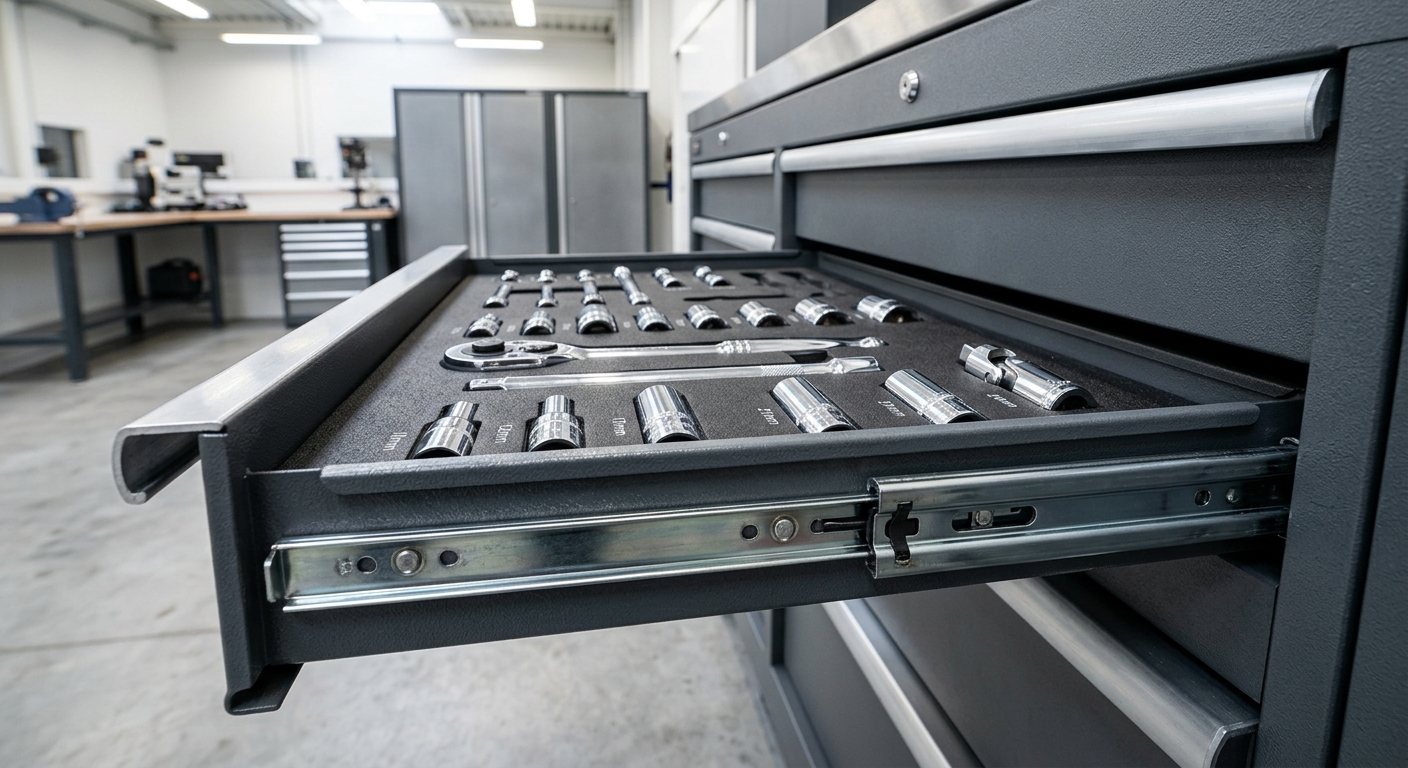
Execution Note: Specify PU casters with grease zerks for heavy duty tool storage systems for automotive and aerospace applications, as these environments demand frequent mobility over uneven surfaces.
SAFEWELL Procurement Watchpoints
Navigating OEM tool trolley manufacturing requires more than just checking a spec sheet. Based on our OEM/ODM workflow, here are the critical watchpoints buyers must manage to protect their margins and lead times.
MOQ and Spec-Lock Notes
- For industrial distributors, MOQ should be confirmed at the SKU + finish + accessory-bundle level, not just at the broad product-family level.
- Freeze drawings, coating code, lock/caster configuration, carton spec, and spare-parts list before sample sign-off so late quote changes do not spill into lead time.
- If mixed-SKU or mixed-color loading matters, ask for the supplier's rule set up front instead of assuming the first MOQ applies to every combination.
QC Watchpoints Buyers Should Put in Writing
- Do not approve the RFQ until the supplier agrees on critical-to-quality items such as modular fit, shelf/drawer compatibility, and finish consistency across mixed configurations.
- Ask for photo or video evidence for packaging protection for corners, drawer faces, and moving components during export transit, because these are exactly the items that tend to trigger claims later.
- Agree on who signs off IQC / IPQC / OQC checkpoints and which defects count as claimable, rather than leaving that decision to the factory floor at shipment time.
Packaging and Claims Pitfalls
- Treat packaging as a commercial-risk topic, not a late-stage admin task. Corner crush, drawer-face rubbing, and hardware damage usually become margin problems, not just warehouse problems.
- Define a claims pack in advance: batch reference, photos, response window, spare-parts policy, and credit/replacement path. This shortens after-sales friction when defects appear.
- If the order is export-facing, confirm carton strength, pallet rules, moisture protection, and movement restraint before the first container leaves the plant.
Supplier Audit Scorecard
When evaluating potential partners for bulk orders, use this weighted scorecard to ensure they meet industrial standards.
| Evaluation Criteria | Weight | Key Indicators to Assess |
|---|---|---|
| Manufacturing Capability | 30% | Automated laser cutting, CNC bending, robotic welding, monthly production capacity. |
| Quality Control (QC) | 25% | In-house testing (load, salt-spray, cycle testing), ISO 9001 certification, defect rate. |
| R&D & Customization | 20% | CAD/CAM capabilities, OEM tool trolley manufacturing experience, rapid prototyping turnaround. |
| Financial Stability | 15% | Years in business, raw material purchasing power, factory ownership. |
| Export Experience | 10% | Familiarity with international packaging standards, logistics management, global client base. |
Procurement Checklist
- RFQ Preparation: Define exact dimensions, steel gauge, drawer count, and target load capacities.
- Customization Specs: Provide RAL color codes, logo placement requirements (e.g., silk screen or aluminum badge), and packaging design files.
- Sampling: Request a pre-production sample (PPS) to verify weld quality, drawer slide smoothness, and paint finish.
- MOQ Verification: Confirm Minimum Order Quantities at the SKU and finish level, including mixed-loading rules.
- Lead Time: Establish clear timelines for sampling (typically 15-20 days) and mass production (35-45 days).
- Quality Control (QC): Mandate third-party or internal inspections focusing on load testing, salt spray testing, and drop testing.
- Packaging: Specify export-grade packaging (e.g., 5-ply corrugated cartons, honeycomb board protection, corner guards, and palletization).
- Compliance: Ensure the factory holds ISO 9001 certification and products meet relevant safety standards.
- Payment Terms: Negotiate standard B2B terms (e.g., 30% T/T deposit, 70% against copy of B/L).
- After-Sales & Claims: Define the warranty period, claims pack requirements, and the exact process for requesting replacement parts.
Frequently Asked Questions
What is the standard lead time for OEM tool trolley manufacturing?
Standard mass production typically requires 35-45 days after pre-production sample (PPS) approval. When planning your procurement schedule, factor in an additional 15-20 days at the front end for initial sampling and CAD drawing approvals. To execute smoothly, freeze all specifications before sample sign-off to prevent late quote changes from spilling into your production lead time.
How do we verify rolling tool cabinet load capacity before mass production?
Require the factory to perform dynamic load testing on the casters and static load testing on fully extended drawer slides. The testing criteria must reflect the actual weight of industrial tools, not just empty volume. As an execution note, mandate documented video evidence of these tests or require verification by a third-party inspection agency before authorizing the final shipment.
Can we mix different colors and SKUs in a single shipping container?
Yes, but this is strictly subject to the supplier's MOQ rules. Factories often have different minimums for custom powder coating colors versus standard finishes. Always negotiate mixed-SKU and mixed-color loading terms during the initial RFQ phase to avoid unexpected surcharges, and ask for the supplier's rule set up front instead of assuming the first MOQ applies to every combination.
What MOQ assumptions should buyers confirm before launching a heavy duty tool storage systems program?
Buyers should confirm MOQ at the SKU, finish, and accessory-bundle level rather than assuming one product-family MOQ applies to every combination. This avoids late quoting changes and mixed-load misunderstandings.
Which QC checkpoints matter most when approving a heavy duty tool storage systems supplier?
The RFQ should define incoming, in-process, and outgoing checks, plus who signs off on drawer alignment, weld consistency, finish quality, hardware fit, and packaging condition before shipment.
How should buyers validate lead time for heavy duty tool storage systems orders?
Lead time should be checked against confirmed capacity, material readiness, sample approval timing, and peak-season risk. Buyers should ask what changes trigger a new production schedule.
Relevant Standards & References
- ISO 9001: Quality Management Systems: https://www.iso.org/iso-9001-quality-management.html
- ASTM International: Standard Test Methods: https://www.astm.org/
- ANSI/BIFMA: Furniture Sustainability and Safety Standards: https://www.bifma.org/
- REACH: European Chemicals Agency (Powder Coating Compliance): https://echa.europa.eu/regulations/reach/understanding-reach
Related Reading
Continue with a few closely related product, OEM, and comparison pages.
- Tool Storage Product Range - Compare tool cabinet, tool cart, and modular storage options.
- OEM/ODM Program Overview - Review manufacturing workflow, sampling, and quality checkpoints.
- Tool Box Wholesale Buying Checklist - Read another related article from SAFEWELL News.
- How to Launch a Tool Cart OEM Program - Read another related article from SAFEWELL News.
Why Buyers Use SAFEWELL as a Control Point
- Proven OEM/ODM Expertise: SAFEWELL offers comprehensive customization, from CAD design to bespoke drawer configurations and brand-specific powder coating, ensuring your product matches exact market demands.
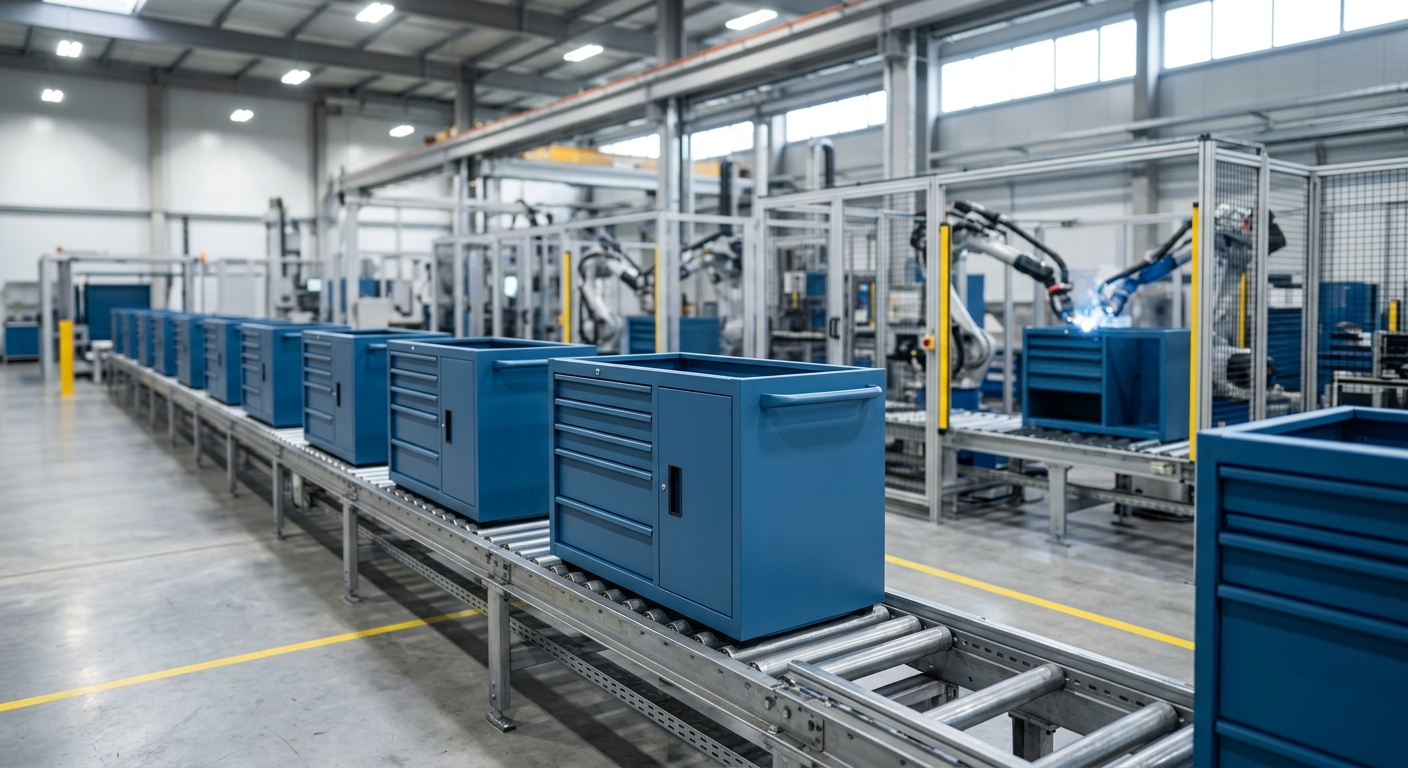
- Robust Manufacturing Capacity: Equipped with automated laser cutting, CNC bending, and advanced welding robotics to ensure consistent precision across bulk orders.
- Strict Quality Control: In-house testing facilities conduct rigorous load-bearing, salt-spray, and cycle tests to guarantee industrial-grade durability before shipment.
- Export-Ready Packaging: We treat packaging as a commercial priority, utilizing reinforced, drop-tested solutions with corner protection to minimize transit damage.
- Transparent Communication: Our workflow locks in specs, MOQs, and claims policies early in the RFQ process, eliminating late-stage surprises and protecting your lead times.
Ready to upgrade your product line with reliable heavy duty tool storage systems? Compile your technical specifications, target load capacities, and customization requirements. Contact the SAFEWELL procurement team today to request a detailed quotation, discuss OEM/ODM possibilities, and arrange for a pre-production sample.
Contact SAFEWELL