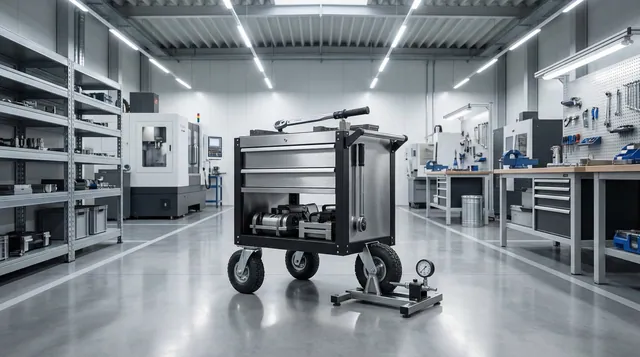
For industrial distributors evaluating supplier replacement, a heavy-duty tool cart program is only as reliable as its mobility system. Preventing caster failure requires more than just selecting a wheel that looks durable on a spec sheet; it demands matching the wheel material to the facility floor, calculating dynamic load capacities rather than relying on static limits, and auditing the quality control standards of the manufacturer. High-load workshops must specify heavy-duty industrial casters with precision bearings and reinforced steel forks to withstand continuous impact and debris. This guide exposes the common failure points that create claim costs and delivery drift, providing a clear path to stabilize your procurement program.
Risk Control Priorities
- Shortlist evidence-based suppliers: Prioritize manufacturers who document performance specs (load rating, coating system, spare parts plan), not just brochure claims.
- Lock down the OEM/ODM spec pack: Freeze dimensions, drawer layouts, locks, accessories, color, logo placement, and packaging before sampling.
- Validate QC checkpoints: Define incoming, in-process, and final accept/reject rules to reduce batch-to-batch drift.
- Confirm commercial rules: Put MOQ, lead time, and change-control rules in writing, specifically regarding material substitutions and tolerance limits.
Where Buyers Usually Lose Control
When evaluating how to choose a tool cart, real-world user feedback exposes the exact failure points that B2B buyers must engineer out of their RFQs.
Analysis of end-user feedback on lower-cost ($100-$150) consumer-grade carts on platforms like Amazon reveals critical structural and logistical failures. Users frequently report casters flat-spotting, rigs bending under offset loads, and bearings seizing. While these are consumer-tier products, they highlight the exact manufacturing shortcuts—such as using unreinforced caster plates or cheap thermoplastic rubber—that industrial buyers actively seek to avoid in professional environments.
Furthermore, discussions in professional welding and fabrication communities (such as Reddit's r/Welding and r/Tools) reinforce the need for robust mobility. End-users frequently modify carts to handle uneven, flat-surface job sites or to hold heavy modular storage boxes without becoming unbalanced. Feedback shows that high-quality steel frames often outlast their original casters, making aftermarket caster compatibility and initial OEM caster quality paramount for long-term brand reputation.
Finally, when evaluating supplier communication and after-sales support, buyer feedback on Trustpilot frequently highlights severe breakdowns when claims arise. Complaints regarding unresponsive service or "scam-level" after-sales support prove that a supplier's communication infrastructure is just as critical as their welding. If a caster fails, the speed of the replacement parts policy dictates the distributor's reputation.
Engineering the Tool Cart: Dynamic Loads and Materials
In high-load industrial environments, caster failure rarely happens overnight. It is typically the result of compounding stress factors that degrade the wheel, bearing, or mounting rig over time.
Calculating Dynamic Load Capacity
A frequent error in B2B procurement is relying solely on static load ratings. Static load refers to the maximum weight a tool cart can hold while stationary. Dynamic load capacity refers to the weight the cart can safely support while in motion.
When calculating the required dynamic load capacity, engineers use a standard safety factor to account for uneven floors. The industry standard dictates dividing the total desired load (cart weight plus maximum payload) by three, rather than four. This assumes that on an uneven surface, only three of the four casters will bear the entire weight of the cart at any given moment. Specifying casters based on this formula prevents premature rig bending and bearing collapse.
Specifying Caster Wheel Materials
The caster wheel materials must balance load-bearing capacity with floor protection, noise reduction, and chemical resistance.
- Polyurethane (PU): The industry standard for high-load tool carts. PU wheels offer the load capacity of steel while providing the floor protection of rubber. They resist oils, greases, and most industrial chemicals.
- Forged Steel / Cast Iron: Used for extreme load capacities where floor protection is not a priority (e.g., heavy fabrication shops). They offer the highest weight ratings and are impervious to sharp debris, but offer zero shock absorption.
- Thermoplastic Rubber (TPR): Excellent for shock absorption and quiet operation, but has lower load capacities and is susceptible to degradation when exposed to harsh industrial solvents.
SAFEWELL Risk-Control Notes
To ensure a smooth tool cart sample approval process and reliable mass production, our OEM/ODM workflow incorporates the following proprietary buyer notes to mitigate risk.
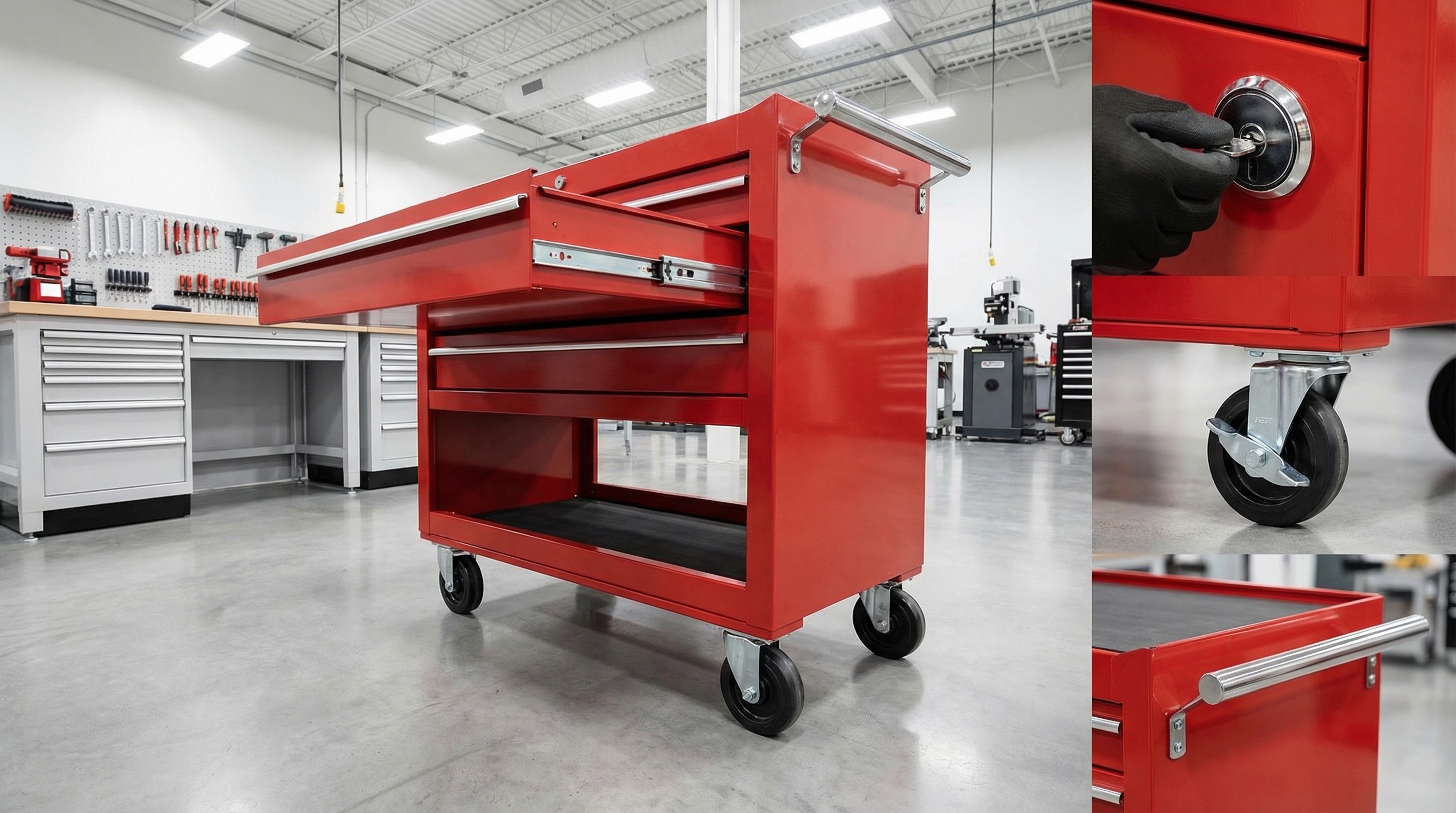
MOQ and spec-lock notes
- For industrial distributors, tool cart MOQ and lead time should be confirmed at the SKU + finish + accessory-bundle level, not just at the broad product-family level.
- Freeze drawings, coating code, lock/caster configuration, carton spec, and spare-parts list before sample sign-off so late quote changes do not spill into lead time.
- If mixed-SKU or mixed-color loading matters, ask for the supplier's rule set up front instead of assuming the first MOQ applies to every combination.
QC watchpoints buyers should put in writing
- Do not approve the RFQ until the supplier agrees on critical-to-quality items such as caster brake consistency, rolling resistance, and weld fatigue around the handle/caster plate.
- Ask for photo or video evidence for cart stability under offset loads and over uneven workshop floors, because these are exactly the items that tend to trigger claims later.
- Agree on who signs off IQC / IPQC / OQC checkpoints and which defects count as claimable, rather than leaving that decision to the factory floor at shipment time.
Packaging and claims pitfalls
- Treat packaging as a commercial-risk topic, not a late-stage admin task. Corner crush, drawer-face rubbing, and hardware damage usually become margin problems, not just warehouse problems.
- Define a claims pack in advance: batch reference, photos, response window, spare-parts policy, and credit/replacement path. This shortens after-sales friction when defects appear.
- If the order is export-facing, confirm carton strength, pallet rules, moisture protection, and movement restraint before the first container leaves the plant.
Risk Control Scorecard
When transitioning to a new supplier for OEM tool cart manufacturing, distributors must look beyond the spec sheet and audit the supplier's infrastructure. Use this tool cart factory audit scorecard to evaluate potential partners.
| Audit Category | Critical Checkpoints | Warning Signs (Red Flags) | Target Standard |
|---|---|---|---|
| Mobility Testing | Dynamic rolling tests, impact drop tests, obstacle track cycling | Relying only on static load math; no physical test rigs | Documented cycle testing (e.g., 10,000+ cycles at max load) |
| Material Verification | Caster wheel durometer checks, steel gauge verification | Substituting PU with cheap TPR without approval | Incoming Quality Control (IQC) logs for all raw materials |
| Structural Integrity | Weld penetration on caster mounting plates, rig thickness | Spot welds instead of continuous welds on load-bearing joints | Automated welding or strict IPQC on manual welds |
| Corrosion Resistance | Salt spray testing for caster rigs and cart body | Powder coating flaking; untreated steel rigs | 48-72 hour salt spray pass; ISO 9001 certified coating process |
Risk Control Checklist
Use this tool cart quality control checklist to standardize your RFQ process and prevent downstream failures:
- [ ] RFQ scope: Define target market, usage environment, load class, dimensions, and required configuration (drawers/shelves/accessories).
- [ ] OEM/ODM spec pack: Provide drawings or dimensioned sketches, finish/color code, branding placement, and packaging requirements.
- [ ] Sampling plan: Establish pre-production sample rules, golden sample retention, and clear acceptance criteria before mass production.
- [ ] Material and finish: Specify steel gauge ranges, coating process, and corrosion resistance expectations (test method plus threshold).
- [ ] Functional testing: Mandate drawer slide cycle tests, lock function checks, caster load/rolling resistance tests, and stability checks.
- [ ] QC checkpoints: Define the IQC/IPQC/OQC checklist, AQL level, photo records, and who signs off on critical-to-quality items.
- [ ] Compliance and labeling: Detail carton marks, barcode/label format, hazardous substance requirements, and pallet requirements (e.g., ISPM-15).
- [ ] Lead time plan: Confirm capacity, peak-season buffers, partial shipment rules, and version control if specs change.
- [ ] After-sales and claims: Require a spare parts list, warranty scope, defect classification, and a written claim workflow with timelines.
- [ ] Commercial terms: Lock in Incoterms, payment terms, tooling ownership, confidentiality/IP, and change-order pricing rules.
Questions Buyers Ask When Risk Starts Rising
Why do casters flat-spot in high-load workshops?
Flat-spotting occurs when a fully loaded cart sits stationary for extended periods on wheels made of soft materials, like cheap thermoplastic rubber (TPR), or when the dynamic load capacity is exceeded. Specifying high-durometer polyurethane (PU) or forged steel prevents this deformation.
How do we calculate the correct safety factor for dynamic load capacity?
Industry standard dictates dividing the total desired load (the cart's dead weight plus its maximum payload) by three, rather than four. This accounts for uneven workshop floors where only three casters may bear the full weight of the unit at any given moment.
Can we substitute polyurethane (PU) wheels with thermoplastic rubber (TPR) to save costs?
While TPR offers excellent shock absorption and quiet operation, it has significantly lower load capacities and degrades quickly when exposed to harsh industrial solvents. For heavy-duty industrial applications, PU remains the standard for balancing load capacity, chemical resistance, and floor protection.
How should buyers validate lead time for tool cart orders?
Lead time should be checked against confirmed capacity, material readiness, sample approval timing, and peak-season risk. Buyers should ask what specific design or material changes will trigger a new production schedule.
What MOQ assumptions should buyers confirm before launching a tool cart program?
Buyers should confirm MOQ at the SKU, finish, and accessory-bundle level rather than assuming one product-family MOQ applies to every combination. This avoids late quoting changes and mixed-load misunderstandings.
Which QC checkpoints matter most when approving a tool cart supplier?
The RFQ should define incoming, in-process, and outgoing checks, plus who signs off on drawer alignment, weld consistency, finish quality, hardware fit, and packaging condition before shipment.
Control Standards & References
Related Reading
Continue with a few closely related product, OEM, and comparison pages.
- Tool Cart Solutions - Review rolling cart options and capacity classes.
- OEM/ODM Program Overview - Review manufacturing workflow, sampling, and quality checkpoints.
- Tool Box Wholesale Buying Checklist - Read another related article from SAFEWELL News.
- How to Launch a Tool Cart OEM Program - Read another related article from SAFEWELL News.
Where SAFEWELL Helps Buyers Stabilize Execution
For distributors seeking a reliable manufacturing partner to replace underperforming suppliers, SAFEWELL provides robust, scalable solutions designed specifically for high-load environments.
- Advanced Tool Cart OEM ODM Customization: SAFEWELL engineers tailor caster configurations—including wheel material, bearing type, and rig thickness—to meet the specific dynamic load and environmental requirements of your target market.
- Rigorous QC Checkpoints: Every batch undergoes strict dynamic load testing, impact resistance checks, and salt spray corrosion testing to ensure long-term durability and eliminate premature field failures.
- Predictable B2B Metrics: With standardized lead times and flexible MOQs for custom OEM projects, SAFEWELL supports efficient, risk-free supply chain management.
- Export-Ready Packaging: We treat packaging as a critical commercial-risk topic, utilizing reinforced cartons and strict palletization rules to ensure your carts arrive without transit damage.
Upgrading your product line requires a manufacturing partner capable of executing precise technical specifications without introducing new risks. SAFEWELL's OEM/ODM customization capabilities ensure your tool carts are equipped with the exact mobility solutions your end-users demand. Contact our engineering team today to submit your RFQ, request load-testing documentation, and begin prototyping your next high-performance industrial storage solution.
Contact SAFEWELL