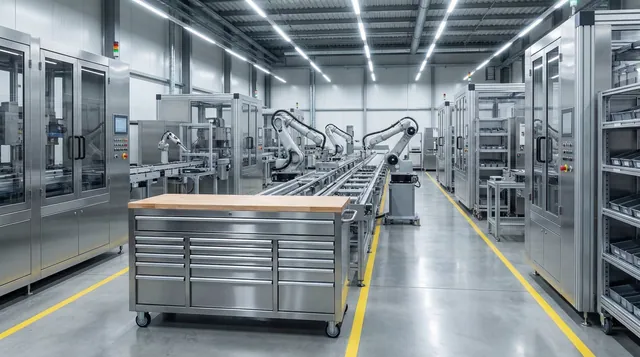
Replacing a manufacturing partner for your industrial storage line is a high-stakes operational move. A strategic tool cabinet supplier transition requires a structured handover plan to mitigate risks related to product consistency, lead times, and spare parts continuity. For industrial distributors and global brand owners, a seamless switch is critical to maintaining end-user trust and protecting profit margins.
Before phasing out a legacy supplier, procurement teams must validate the new manufacturer's production capacity, quality control checkpoints, and OEM/ODM capabilities. This memo breaks down the exact validation steps required to execute a supplier transition without disrupting your supply chain.
Qualification Priorities
- Evidence over claims: Shortlist suppliers who can document performance specs (load rating, coating system, spare parts plan), not just brochure claims.
- Spec lockdown: Freeze an OEM/ODM spec pack before sampling, including dimensions, drawer layout, locks, accessories, color, logo placement, and packaging.
- Process control: Validate QC checkpoints (incoming, in-process, final) and define accept/reject rules to reduce batch-to-batch drift.
- Commercial clarity: Confirm MOQ, lead time, and change-control rules in writing, specifically regarding material substitutions and tolerance limits.
Evaluating Tool Cabinet Factory Capability and Field Risks
When evaluating how to choose a tool cabinet manufacturer, field data and end-user feedback reveal the most common failure points that plague poorly managed supplier transitions. Industrial buyers expect strict adherence to structural tolerances and material specifications, and deviations here quickly become margin-eroding claims.
Analysis of end-user feedback highlights critical failures in hardware and structural integrity when production shifts to lower-tier factories. Primary complaints frequently center on cheap assembly hardware—such as stripping screws—and exaggerated weight capacities. While these issues are often dismissed as consumer-level problems, they expose critical failure points highly relevant to B2B industrial storage sourcing. If a new supplier substitutes a different grade of cold-rolled steel or applies a thinner powder coating to reduce costs, premature wear is inevitable.
Furthermore, shop floors are dynamic environments. Technicians frequently mix and match equipment, such as integrating specific diagnostic scanners into standard drawers. This real-world usage reinforces the need for standardized, compatible drawer dimensions and robust spare parts continuity for legacy systems. A supplier transition cannot mean abandoning the dimensional standards your end-users rely on.
SAFEWELL Qualification Watchpoints
To prevent the issues highlighted by market feedback, procurement teams must enforce strict operational boundaries. Based on our OEM/ODM workflow, here are the critical watchpoints buyers should integrate into their RFQs.
MOQ and Spec-Lock Notes
- For industrial distributors, tool cabinet MOQ and lead time should be confirmed at the SKU + finish + accessory-bundle level, not just at the broad product-family level.
- Freeze drawings, coating code, lock/caster configuration, carton spec, and spare-parts list before sample sign-off so late quote changes do not spill into lead time.
- If mixed-SKU or mixed-color loading matters, ask for the supplier's rule set up front instead of assuming the first MOQ applies to every combination.
QC Watchpoints Buyers Should Put in Writing
- Do not approve the RFQ until the supplier agrees on critical-to-quality items such as drawer gap alignment, slide consistency, anti-tip behavior, and lock system fit.
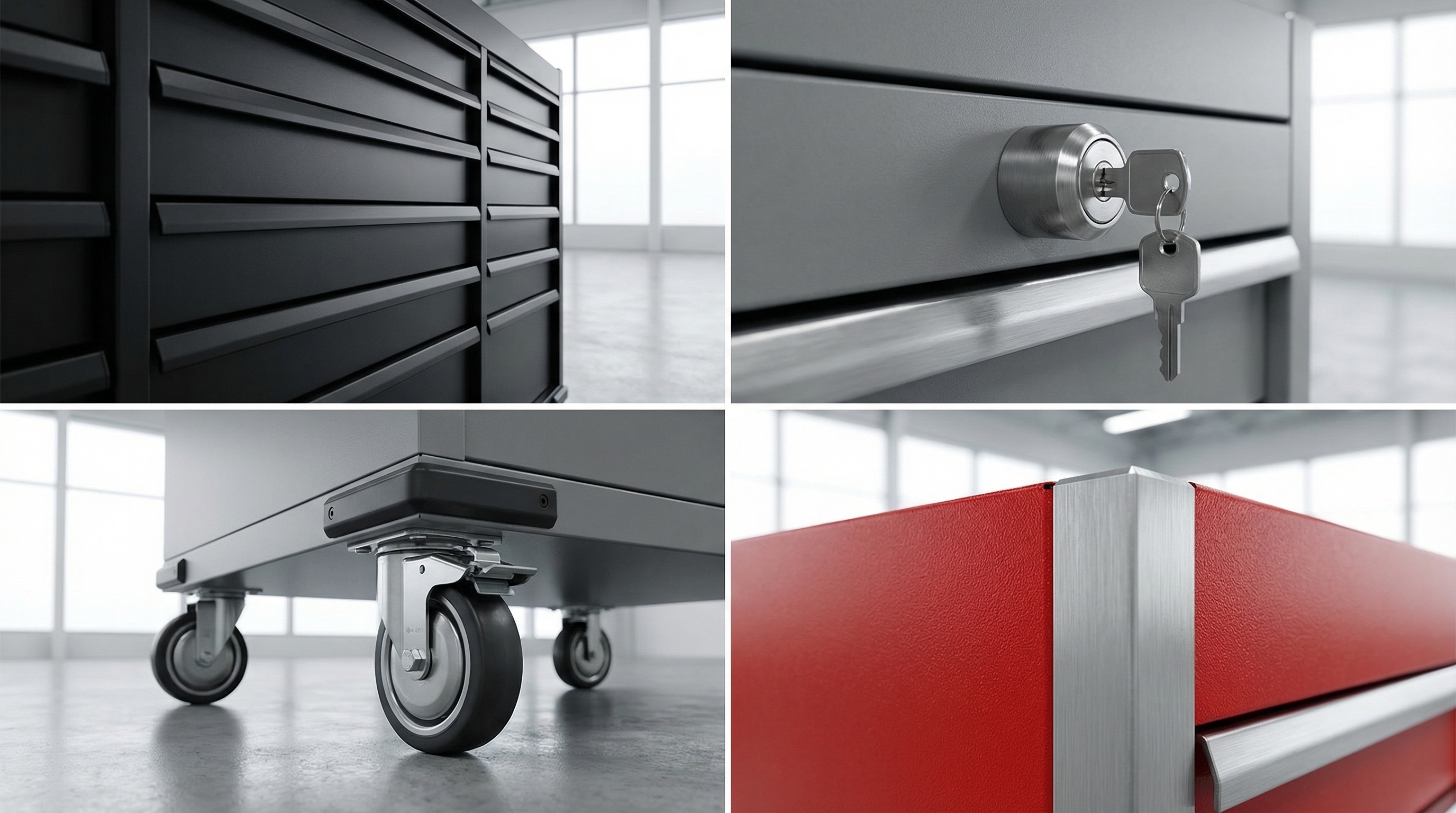
- Ask for photo or video evidence for powder coating edge coverage around drawer fronts, corners, and high-touch zones, because these are exactly the items that tend to trigger claims later.
- Agree on who signs off IQC / IPQC / OQC checkpoints and which defects count as claimable, rather than leaving that decision to the factory floor at shipment time.
Packaging and Claims Pitfalls
- Treat packaging as a commercial-risk topic, not a late-stage admin task. Corner crush, drawer-face rubbing, and hardware damage usually become margin problems, not just warehouse problems.
- Define a claims pack in advance: batch reference, photos, response window, spare-parts policy, and credit/replacement path. This shortens after-sales friction when defects appear.
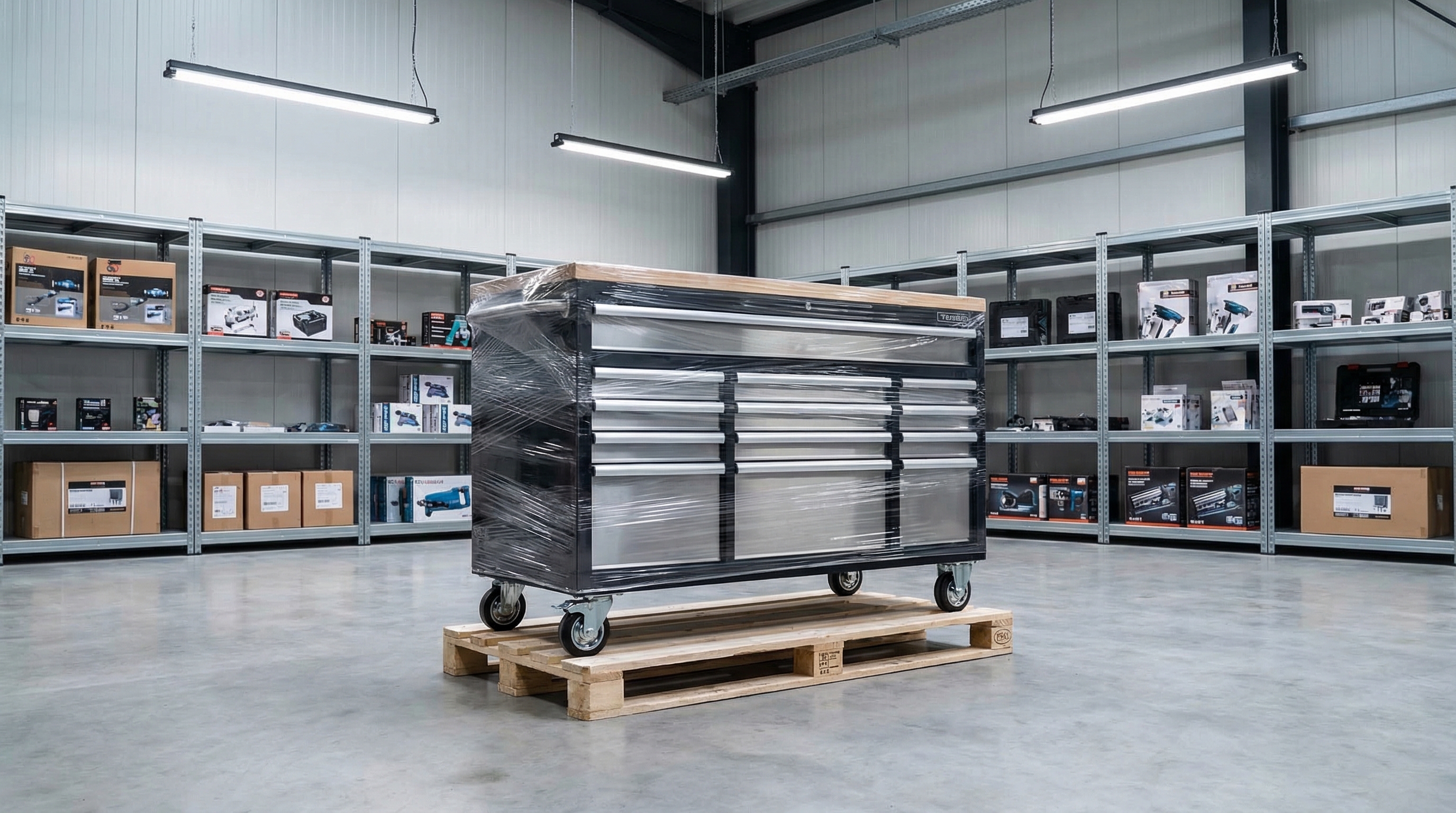
- If the order is export-facing, confirm carton strength, pallet rules, moisture protection, and movement restraint before the first container leaves the plant.
Supplier Qualification Scorecard
Use a structured tool cabinet factory audit scorecard to remove emotion from the decision-making process and align procurement with engineering.
| Evaluation Criteria | Red Flag (High Risk) | Green Light (Low Risk) | Weight |
|---|---|---|---|
| Production Capacity | Outsourced laser cutting/welding; erratic lead times. | In-house automated fabrication; clear capacity planning. | 25% |
| Quality Control (QC) | No documented IQC/OQC; relies on final visual check. | Strict tool cabinet quality control checklist; digital calipers used. | 30% |
| OEM/ODM Engineering | Cannot modify standard designs; no R&D team. | Strong tool cabinet OEM ODM customization capabilities. | 20% |
| Packaging & Export | Standard single-wall cartons; no drop-test data. | Honeycomb reinforced corners; ISPM-15 compliant pallets. | 15% |
| After-Sales Support | Vague warranty terms; no spare parts inventory. | Defined SLA; guaranteed spare parts continuity for legacy models. | 10% |
Qualification Checklist
Before finalizing the transition and initiating First Article Inspection, ensure your procurement team has checked off the following requirements:
- RFQ scope: Define target market, usage environment, load class, dimensions, and required configuration (drawers/shelves/accessories).
- OEM/ODM spec pack: Provide drawings or dimensioned sketches, finish/color code, branding placement, and packaging requirements.
- Sampling plan: Establish pre-production sample rules, golden sample retention, and clear acceptance criteria before mass production.
- Material and finish: Document steel gauge ranges, coating process, and corrosion resistance expectations (test method plus threshold).
- Functional testing: Mandate drawer slide cycle testing, lock function, caster load/rolling resistance, and stability checks.
- QC checkpoints: Finalize the IQC/IPQC/OQC checklist, AQL level, photo records, and who signs off on critical-to-quality items.
- Compliance and labeling: Confirm carton marks, barcode/label format, hazardous substance requirements, and pallet rules (e.g., ISPM-15).
- Lead time plan: Lock in capacity confirmation, peak-season buffers, partial shipment rules, and version control for spec changes.
- After-sales and claims: Secure a spare parts list, warranty scope, defect classification, and a written claim workflow with timelines.
- Commercial terms: Agree on Incoterms, payment terms, tooling ownership, confidentiality/IP, and change-order pricing rules.
Questions Buyers Ask During Qualification
How long should a parallel supply run last during a supplier transition?
Maintain a 90-day buffer stock with your legacy supplier while placing a trial order (e.g., 1x20GP container) with the new factory. This allows you to gauge real-world production and shipping timelines without risking stockouts.
Who retains ownership of custom tooling when switching manufacturers?
Tooling ownership must be explicitly defined in your commercial agreement. If you paid for custom drawer extrusion molds or specific stamping dies, ensure your contract includes a tooling release clause allowing you to transfer physical assets or IP to the new supplier.
What MOQ assumptions should buyers confirm before launching a tool cabinet program?
Buyers should confirm MOQ at the SKU, finish, and accessory-bundle level rather than assuming one product-family MOQ applies to every combination. This avoids late quoting changes and mixed-load misunderstandings.
Which QC checkpoints matter most when approving a tool cabinet supplier?
The RFQ should define incoming, in-process, and outgoing checks, plus who signs off on drawer alignment, weld consistency, finish quality, hardware fit, and packaging condition before shipment.
How should buyers validate lead time for tool cabinet orders?
Lead time should be checked against confirmed capacity, material readiness, sample approval timing, and peak-season risk. Buyers should ask what changes trigger a new production schedule.
What should be included in the after-sales and claims workflow for tool cabinet?
Define batch traceability, photo requirements, response window, spare-parts policy, and credit or replacement path in writing before the first shipment so claims do not become ad-hoc negotiations.
Compliance and Verification References
Related Reading
Continue with a few closely related product, OEM, and comparison pages.
- Industrial Tool Cabinet Product Detail - Check core structure, drawer layout, and component specifications.
- Tool Storage Product Range - Compare tool cabinet, tool cart, and modular storage options.
- Tool Box Wholesale Buying Checklist - Read another related article from SAFEWELL News.
- How to Launch a Tool Cart OEM Program - Read another related article from SAFEWELL News.
Where SAFEWELL Helps Buyers Screen Supplier Risk
For distributors navigating a supplier transition, SAFEWELL provides a stable, highly capable manufacturing environment designed for international B2B partnerships.
- Advanced OEM/ODM Customization: SAFEWELL's core advantage lies in its robust tool cabinet OEM ODM customization capabilities, allowing distributors to seamlessly replicate legacy designs or engineer entirely new storage solutions tailored to specific industrial niches.
- Strict QC Checkpoints: Every production run undergoes rigorous testing, including SPCC steel gauge verification, powder coating adhesion tests, and dynamic load testing on drawer slides, ensuring zero specification drift.
- Scalable Production Capacity: With extensive manufacturing facilities, SAFEWELL easily accommodates trial MOQs while possessing the scale to handle high-volume, multi-container monthly orders, mitigating lead time fluctuations.
- Transparent Claim Processes: SAFEWELL operates with clear SLAs and dedicated after-sales support, ensuring that any rare defects are handled swiftly with structured claim processes and replacement guarantees.
Ready to upgrade your supply chain with a reliable manufacturing partner? Contact SAFEWELL today to discuss your specific OEM/ODM requirements, request a prototype, and begin a secure, phased transition for your industrial storage product lines.
Contact SAFEWELLPrepared by SAFEWELL Industrial Content Team and reviewed against SAFEWELL buyer-support and manufacturing workflow team.